


 By David Lange, Partner, Governance, Risk and Compliance, Weaver
For twenty years, the rising cost of being a public company has pushed many startups to stay private as long as they could. A proposal out of Washington and a shift underway in Texas could rewrite that math.
Many life sciences companies that succeed will face a decision about whether or not to go public. In theory it should be an easy call, since the public markets offer the deepest and cheapest pool of capital a growing company can reach. Yet over the past twenty years, more and more founders have hesitated. The reason has had less to do with the appeal than with the price of being public. And much of that price has nothing to do with running the business; it is the cost of staying compliant, year after year. A rule the Securities and Exchange Commission proposed in May could change that.1
What’s on the Table
The proposal does one simple thing: It makes being a public company cheaper and less complicated, especially for smaller companies. The rules that decide which compliance tier a company falls into haven’t been touched since 2005, so inflation alone has pushed far more companies into the most demanding tier than was ever intended. Now, the SEC wants to ease that for roughly four out of every five existing public companies.1,2
The single most expensive obligation — a second, separate audit of a company’s internal financial controls — would fall away for that large majority. Newly public companies would get a guaranteed break of at least five years from that obligation before the heaviest requirements apply, no matter how fast they grow. And, according to a statement by SEC Chair Paul Atkins, the line that defines a “large” company, frozen at $700 million for two decades, would rise to $2 billion.1,3 Status would also be measured as an average over two years rather than a single day’s snapshot, so a company couldn’t be swept into the most expensive tier by a brief jump in its stock price.1 The table below translates the change into plain terms.
| Today | If the proposal passes | |
| The cost of being public | Among the heaviest for small companies | Sharply lower for roughly four of every five public companies |
| The most expensive audit requirement | Kicks in once a company is valued near $700 million — a line unchanged since 2005 | Doesn’t apply until $2 billion |
| A short-term jump in value | One measuring day above the line can lock you in for years | Averaged over two years so brief spikes don’t count |
| Grace period after going public | Up to five years | At least five years, however fast the company grows |
| How the rules are organized | A patchwork of five overlapping categories | One simple category covering about 81% of companies |
| The smallest companies | Standard deadlines | More breathing room to file |
How the rules would change, in plain terms. Sources: SEC; Federal Register; Chairman Atkins statement.
I’ll offer one observation on this, after 20 years working inside these rules: That was the correct standard, and it’s still the letter of the law. Over two decades, though, “reasonable” has drifted toward something closer to “absolute,” which sounds like a noble goal, but the work required to chase down that last sliver of doubt is wildly disproportionate to what it actually tells an investor — and the cost of that has fallen hardest on the smallest companies, the ones least able to carry it. This is the first serious attempt in years to bring the burden back into proportion.
Why the Cost Bites Hardest in Life Sciences
Most companies that go public already sell something. A biotech company often doesn’t. It can take more than a decade to bring a therapy to market, and for nearly all of that stretch the company is spending, not earning. In that world, the fixed cost of being public competes directly with the lab. Every dollar spent proving out financial compliance is a dollar not spent on research or on patients in a trial.
The figures are hard to ignore. In testimony to Congress, the clinical-stage company Arcutis described watching the cost of that one extra audit climb from about $650,000 to $2.2 million a year, without a dollar of it advancing the science.4 What makes the example sting is how Arcutis got there: Its stock only briefly rose above the $700 million mark on June 30, the single day the SEC uses to measure, before falling back.4 That one day locked it into years of the most expensive audit requirement — exactly the kind of fluke the new two-year averaging is designed to prevent.1
Industry estimates put the typical bill for compliance at near $800,000 a year, about what it costs to fund eight researchers or add up to sixteen patients to a clinical trial.4 As another biotech company, Climb Bio, told the SEC, “Every dollar directed toward compliance activities that provide limited incremental information to investors is a dollar unavailable for advancing clinical development programs.”6 The government’s own watchdog found the burden falls disproportionately on smaller companies, whose costs run about 19% higher than exempt peers.5
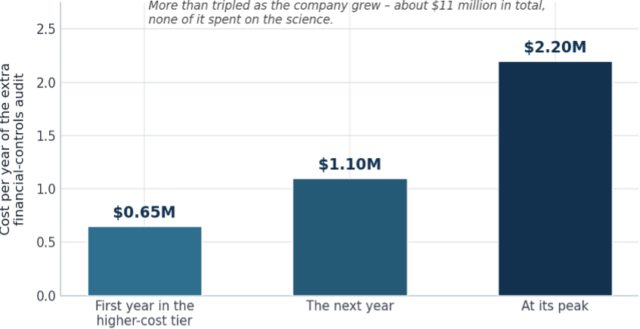
Figure 1. What one clinical-stage biotech (Arcutis) paid each year for the extra financial-controls audit that larger public companies must undergo. Source: Congressional testimony via BIO.
The Window Is Open, and Texas Is Widening It
Timing is another part of the story. After a bleak 2025, biotech is roaring back: the first half of 2026 alone produced 18 U.S. biotech IPOs, more than double all of last year, while the sector’s benchmark index climbed roughly 30% by June.7,8 Money is flowing back into the field at exactly the moment the cost of reaching it may be coming down.
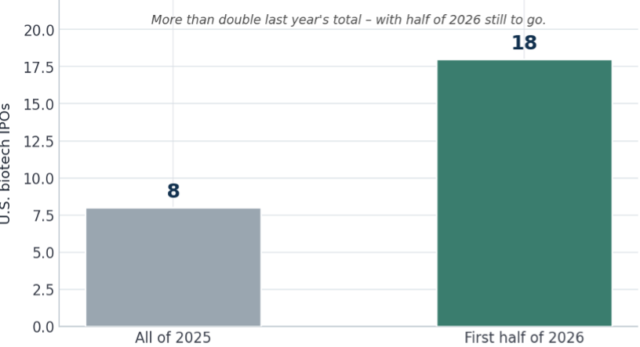
Figure 2. U.S. biotech IPOs, all of 2025 versus the first half of 2026. Sources: BioSpace; J.P. Morgan .
For Houston, there is a second tailwind blowing in the same direction. As Washington moves to lower the federal cost of being public, Texas is busy building a capital market of its own. The Texas Stock Exchange began trading in July, and companies as large as ExxonMobil and Dell have voted to make Texas their legal home.11 The state already hosts roughly one in ten U.S. public companies and a life sciences sector employing more than 116,000 people — much of it clustered around the Texas Medical Center.11 For a founder here, the case for going public is getting stronger from two directions: Washington is easing the cost, and Texas is building the market.
Will It Actually Happen?
Nothing is final yet. The public comment period closed in July, and the proposal drew a healthy mix of applause and pushback.9 There is broad agreement on simplifying the rules; the main debate is over how far to cut the cost for smaller companies, with some investor groups cautioning that protections shouldn’t be trimmed too aggressively.9,10 My read, and the read of most people watching closely, is that some version of this will become law, though the exact dollar lines may shift and a final rule is more likely in late 2026 or 2027 than tomorrow.12
What It Means for You
So what should a life sciences leader do with a rule that isn’t final? A few things:
- Price both scenarios into your IPO timeline. If going public is on the table in the next two years, model the cost of your first five years as a public company under today’s rules and under the proposal. For most pre-revenue companies that gap runs into seven figures, which is enough to change the timing of a raise or the decision itself.
- If you’re already public and worth between $700 million and $2 billion, stage your compliance spending rather than locking it in. The audit fee itself is set annually, but the costs built around it aren’t — added headcount, multi-year software subscriptions and outside readiness projects all commit you well past the current year. With the threshold potentially moving to $2 billion, it’s a reasonable moment to ask which of those commitments can be staged or revisited instead of signed now.
- Remember what would actually go away. The proposal removes the outside auditor’s separate sign-off on your financial reporting — not your obligation to report accurately and not the value of being able to close your books cleanly. Investors, acquirers and partners still judge you on that, and the companies that keep the discipline tend to raise on better terms.
None of this is law yet, but for twenty years the cost of being public moved in one direction, and it is finally set to move in the other. This is a very exciting shift to follow.
Sources
- SEC, “SEC Proposes Transformative Reforms” Press Release 2026-46 (May 19, 2026). https://www.sec.gov/newsroom/press-releases/2026-46-sec-proposes-transformative-reforms-help-public-companies-conduct-registered-offerings-simplify
- SEC Release No. 33-11419 (File No. S7-2026-18), Federal Register (May 21, 2026). https://www.federalregister.gov/documents/2026/05/21/2026-10222/enhancement-of-emerging-growth-company-accommodations-and-simplification-of-filer-status-for
- Chairman Paul Atkins, Statement on the Proposing Releases (May 19, 2026). https://www.sec.gov/newsroom/speeches-statements/atkins-statement-on-proposing-releases-for-enhancement-of-emerging-growth-company-accommodations-and-simplification-of-filer-status-for-reporting-companies-and-registered-offering-reform-051926
- “Onerous reporting requirements crushing small biotechs,” BIO / House testimony, bio.news. https://bio.news/federal-policy/onerous-reporting-requirements-crushing-small-biotechs-bio-board-member-testifies/
- U.S. Government Accountability Office, GAO-25-107500 (2025). https://www.gao.gov/assets/gao-25-107500.pdf
- Climb Bio, Inc., comment letter on File No. S7-2026-18 (SEC). https://www.sec.gov/comments/S7-2026-18/s7202618-952679-2936086.pdf
- “Biotech IPOs Surge in H1 2026,” BioSpace. https://www.biospace.com/business/biotech-ipos-surge-in-h1-2026-shattering-records-and-doubling-last-years-total
- J.P. Morgan, Biopharma Outlook, Q2 2026. https://www.jpmorgan.com/content/dam/jpmorgan/documents/cb/insights/outlook/jpm-biopharma-deck-q2-2026-2.pdf
- SEC, Public Comments on S7-2026-18. https://www.sec.gov/rules-regulations/public-comments/s7-2026-18
- Center for Audit Quality, Audit Committee Council comment letter. https://www.thecaq.org/acc-comment-letter-to-the-sec-filer-status-for-reporting-companies
- Clifford Chance, “The Texas Stock Exchange: A New Exchange, A Broader Shift” (July 2026). https://www.cliffordchance.com/content/dam/cliffordchance/briefings/2026/07/The%20Texas%20Stock%20Exchange_%20A%20New%20Exchange,%20A%20Broader%20Shift
- Fenwick, “SEC Publishes Spring 2026 Reg Flex Agenda.” https://whatstrending.fenwick.com/post/sec-publishes-spring-2026-reg-flex-agenda