

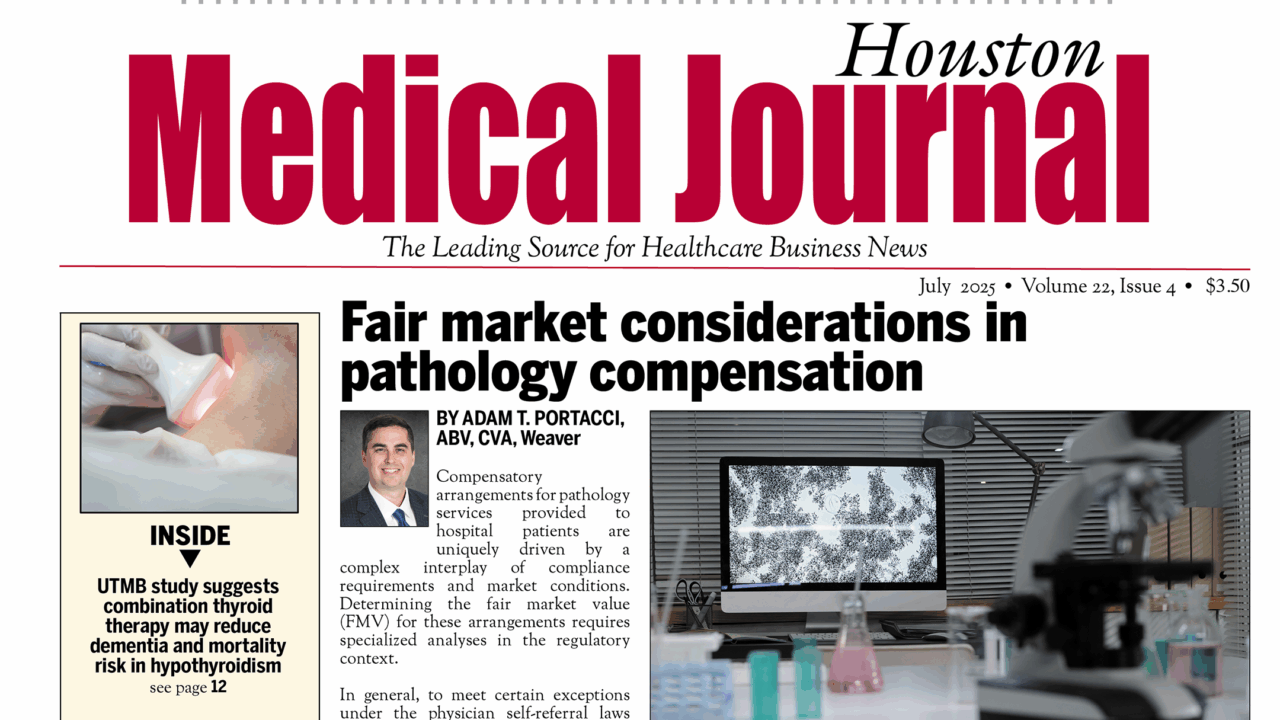
Medical Journal July 2025 Digital Edition
July 19, 20251 min
Post Views: 892

Harris Health and Harris County successfully closed on the first of three planned sales of voter authorized limited tax bonds. The proceeds from this $840 million sale are to be used to fund the continued construction of Harris Health’s new Level I trauma-capable hospital being built on the Harris Health Lyndon B. Johnson Hospital campus. In addition to this facility, the system is in the midst of planning and design work for future capital improvements...

BY Adam Portacci, Weaver Compensation arrangements for pathology services provided to hospital patients are uniquely driven by a complex interplay of compliance requirements and market conditions. Determining the fair market value (FMV) for these arrangements requires specialized analyses in the regulatory context. In general, to meet certain exceptions under the physician self-referral laws (commonly referred to as Stark) from the Centers for Medicare & Medicaid Services (CMS) and certain safe harbors under the Anti-Kickback Statute...

BY Phuong Nguyen, Esq. and Michael Alexander, Esq., Brown & Fortunato, P.C. Earlier this year, we wrote about the information blocking provisions of the 21st Century Cures Act (the “Cures Act”) and concerns related to the requirement to disclose medical information, particularly lab results. A new Texas law was passed that appears to largely address those concerns by requiring a 3-day delay for sensitive lab results. To recap, the Cures Act was passed in...

BY Samuel Mathis, MD, MBA In 2018, a NIH report was published regarding the rates of obesity in America. They found that nearly 1 in 3 American adults are overweight and over 42% of adults have obesity. The prevalence of obesity has also been increasing over time with it showing up earlier in age among children and teens as well. Over the past 20+ years, rates of obesity have climbed 12%. With the numerous...

BY John Hawkins, President & CEO, THA It occupied our time and our minds as much as any issue can while sharing the stage with a state legislative session. For nearly six months, it consumed us. But we made sure it didn’t consume Texas Medicaid. When negotiations began in Congress early this year on a federal budget “mega-bill” that targeted Medicaid cuts as a major cost offset, we at the Texas Hospital Association...
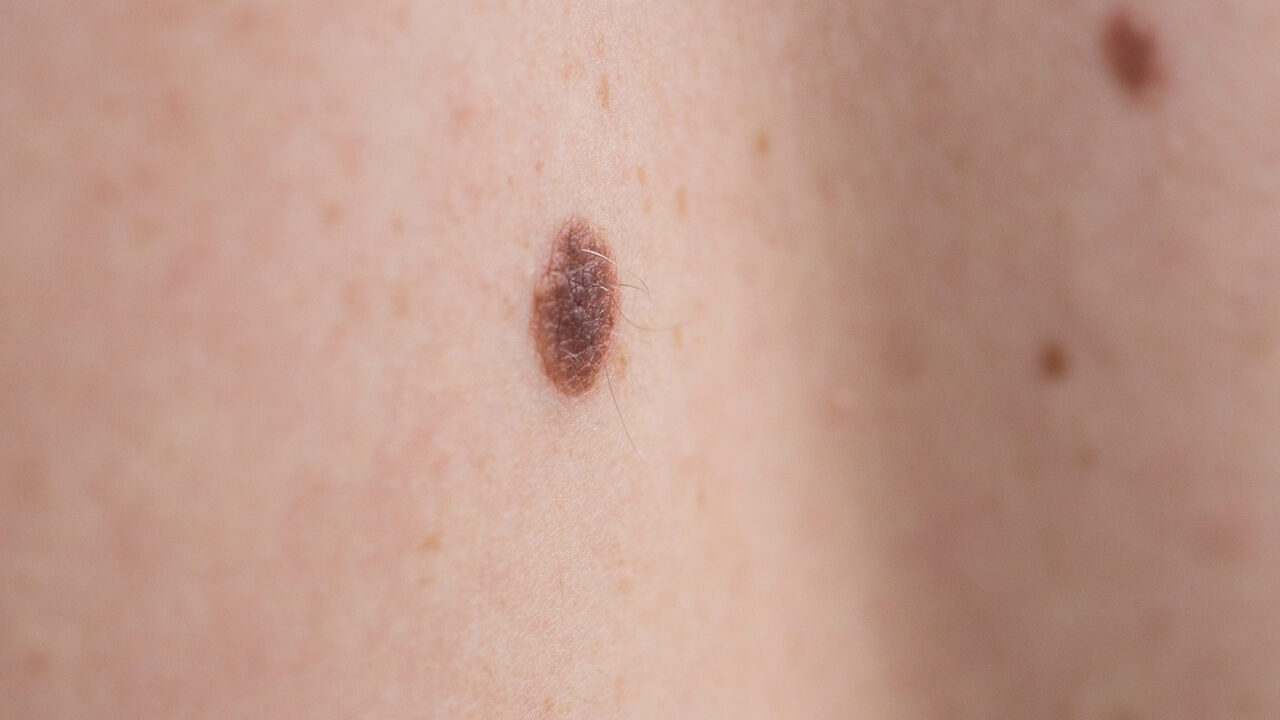
Four years after pre-surgery treatment with a novel combination of immune checkpoint inhibitors, nivolumab and relatlimab, 87% of patients with stage III melanoma remained alive, according to new results from a study led by researchers at The University of Texas MD Anderson Cancer Center. Long-term follow-up data from this Phase II study demonstrate this combination provides long-term benefits to patients when given before and after surgery, and identified unique biomarkers associated with better outcomes and lower chance of recurrence....

In a major step forward for pandemic preparedness and vaccine development, scientists at the University of Texas Medical Branch and Moderna have developed and tested a groundbreaking mRNA vaccine that provides full protection against the deadly Marburg virus and the closely related Ravn virus in a preclinical animal model. “The fact that we achieved complete protection in all vaccinated animals is a major leap,” said Dr. Alexander Bukreyev, co-senior author of the study and professor...

New targeted therapies have improved treatment options for elderly patients with IDH-mutant acute myeloid leukemia (AML) who are not eligible for intensive chemotherapy, with two double therapy regimens approved as frontline therapies. However, most patients either do not benefit or will experience a relapse. Therefore, researchers led by Courtney DiNardo, M.D., evaluated new triplet regimens in 60 newly diagnosed, elderly patients with IDH-mutated AML who were ineligible for chemotherapy, including: Azacitidine, venetoclax and ivosidenib for patients with IDH1 mutation Oral decitabine, venetoclax and ivosidenib...

Many patients with brain metastases receive stereotactic radiation therapy (SRT) – a targeted high dose of radiation – after surgery to remove the metastases. Studies have suggested that pre-surgical SRT may be comparable to standard post-surgical SRT, but little is known about both methods from clinical trials. To address this, researchers led by Debra Nana Yeboa, M.D., conducted a Phase III clinical trial examining the logistics and short-term safety of both pre- and post-surgical SRT in 103 patients with resectable brain metastases. Compared...