

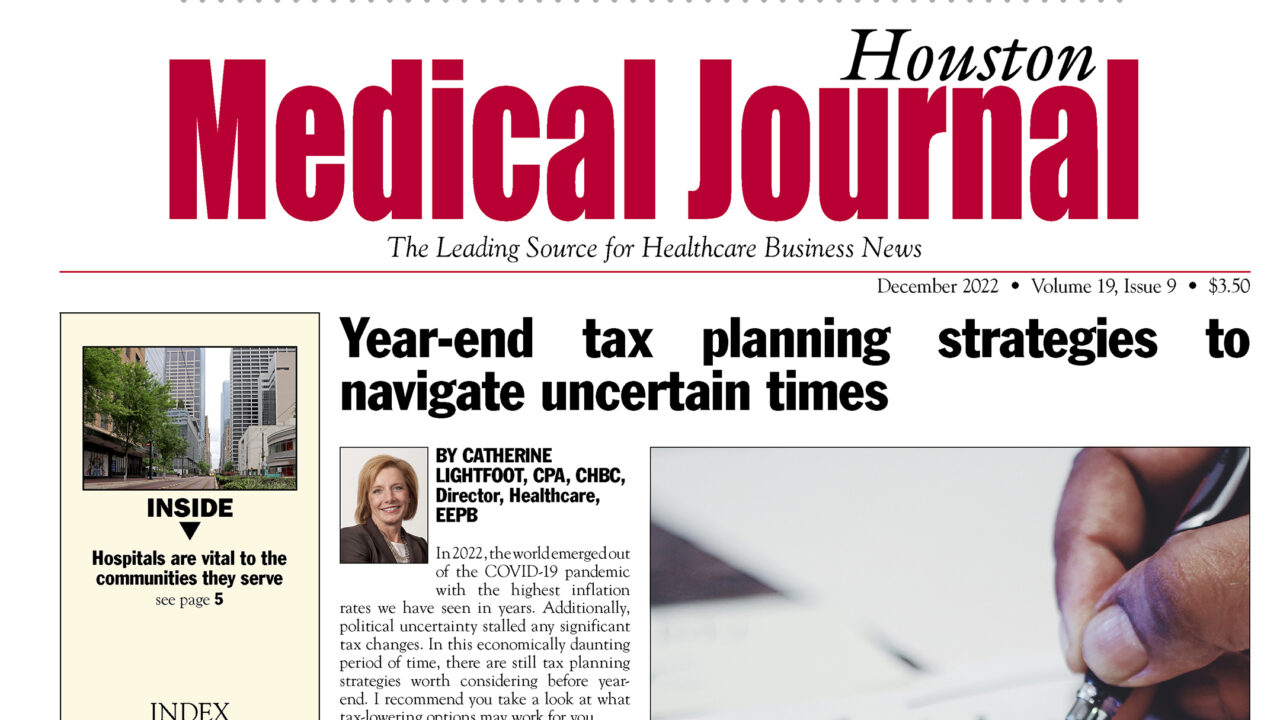
Medical Journal December 2022 Digital Edition
December 20, 20221 min
Post Views: 1,429

By Catherine Lightfoot, CPA, CHBC, Director of Healthcare at EEPB In 2022, the world emerged out of the COVID-19 pandemic with the highest inflation rates we have seen in years. Additionally, political uncertainty stalled any significant tax changes. In this economically daunting period of time, there are still tax planning strategies worth considering before year-end. I recommend you take a look at what tax-lowering options may work for you. Harvesting Capital Losses Review your investments...

By Jacque S. Mayes and Beth Anne Jackson, Brown & Fortunato On May 10, 2021, the Department of Health and Human Services (HHS) announced that the Office for Civil Rights would interpret and enforce Section 1557 and Title IX’s prohibitions on discrimination based on sex to include: (1) discrimination on the basis of sexual orientation; and (2) discrimination on the basis of gender identity (the “Notification”). Section 1557 prohibits discrimination on the basis of...

By Kevin Troutman, Partner, Fisher Phillips Here in the midst of the season for holiday gatherings, it is not too late for administrative and human resources (HR) leaders to review their plans and to help ensure that a holiday party does not turn into a visit from “the Grinch,” fraught with headaches and unpleasant surprises. Although parties typically boost morale and build comradery, they can also become hotbeds for potential employer liability. While...

By John Hawkins, President/CEO, THA As the pandemic tapers off, the need for hospitals has not. With surges of respiratory illnesses inundating emergency departments, hospitals – and hospital workers – remain our most unwavering line of defense. But even as hospitals continue to support their communities in the most urgent and visible ways – the ways everyone associates them with – we should keep in mind the more stealth impacts that hospitals make...

By Samuel Mathis, MD, FAAFP, Assistant Professor, Department of Family Medicine, Medical Director, Employee Health, UTMB As we enter into this 2nd week of January, our new year’s resolution should be in full swing. Most people are still keeping up with their resolutions. One thing that can help with your (SMART) goal is to understand how habits are formed. In his book, The Power of Habit, Charles Duhigg talks about the science behind habits...

Imagine a 68-year-old patient who has COVID-19. Most likely she will also have high blood pressure and kidney problems as these issues often go together in older adults. When she goes to see a doctor, the treatment cannot just focus on the COVID-19 infection, but also needs to consider the other health conditions, and factor them into an overall health risk and treatment plan. To help health care professionals find the connections between health...

Researchers from The University of Texas MD Anderson Cancer Center are presented compelling findings from three clinical trials. These oral presentations highlight encouraging results to advance the use of targeted therapies and novel combinations in multiple types of leukemia, including high-risk and newly diagnosed acute myeloid leukemia (AML) in older and younger patients and Philadelphia chromosome-positive acute lymphoblastic leukemia (ALL). Older or high-risk patients with newly diagnosed AML respond well to triplet therapy Researchers observed encouraging response rates in older or high-risk...

The chemotherapy-free regimen of ponatinib and blinatumomab achieved high response rates and reduced the need for an allogeneic stem cell transplant for patients with recently diagnosed Philadelphia chromosome-positive (Ph+) acute lymphoblastic leukemia (ALL), according to results from a Phase II trial. One of the lead investigators, Nicholas Short, M.D., assistant professor of Leukemia, presented the findings recently. “Traditionally, Ph+ ALL responds poorly to standard chemotherapy and is high-risk for relapse, so these survival results and reduced...
A Rice University laboratory, with a boost from the Bill & Melinda Gates Foundation, will develop a once-a-year treatment for patients infected with HIV and other infectious diseases. The Rice lab of bioengineer Omid Veiseh has received a $3 million foundation grant to develop implants that produce and deliver monoclonal anti-HIV antibody (mAb) therapeutics for at least a year. Michael Diehl, an associate professor of bioengineering and chemistry at Rice, is co-investigator on the grant. The project joins Veiseh’s other implantable...